Thursday, July 12, 2012

The Beach

Black Skimmer
While many love the allure of the beach to watch the ocean, tan, or swim, I find inspiration from watching the animals. Sometimes you would never know some creatures are there until you walk along a beach at dawn or dusk. I really love Margate for these purposes because it is not overly populated with people much of the time. Last summer, we came upon a Searobin trapped in the surf and were able to save it before it died out of the water. Being an amateur photographer, I often bring my Rebel to the beach even though this is a bit unnerving. This past weekend was particularly fruitful in the nature discovery area of things. Of course, I caught an Atlantic Mole Crab burrowing in the sand. They are so cute, it is just about irresistible to pick them up!

Striped Burrfish
Atlantic Needlefish
This crab, however is normal to find at the beach. I was particularly excited about the Striped Burrfish and Atlantic Needlefish that we found on the shore. The Burrfish was quite easy to identify, but the other one took hours to name. I had to search many ways online in order to even get on the right track for identifying this fish! Apparently, the Needlefish, though small, is more dangerous than sharks to fishermen. They can jump out of the water at 30mph and impale people, commonly at night! Their mout can break off and leave a person impaled. This is a small specimen for the species, so they can grow much larger and can be even fatal.

The picture of the bird at the top is my favorite find for the trip. Called a Black Skimmer, this bird spends the mornings and nights flying up and down the beach in the surf "skimming" for food. This is an endangered bird in New Jersey, and so was a great find! The first night we were there, there were about ten, but by the time I brought my camera to the beach there was only one left in the area. These majestic birds are threatened throughout the Atlantic coast, however, because they are beach-nesting birds and so many beaches have been destroyed by tourists. These birds probably live in the swampy area on the other side of Margate and travel each day to the beach. They are supposed to stay in the same location each season, so I hope to see more of them over the summer!

Tuesday, June 26, 2012

Puerto Rico


Okay, so I have been on vacation the last week to the tropical island of Puerto Rico. It was a dream come true that not even the intense sun burn/smashed knee/multiple bug-bites and sores could dampen. It was amazing. We went to the coral reefs, old city of San Juan, rain forest (El Yunke), and dry forest. I had the chance to take hundreds of pictures while I was there, well over 500. Even the poorer parts of the cities had a quiet beauty about them. The only bad part of the experience was the endless amounts of homeless animals. They were everywhere and while intensely adorable, one could only feel bad for all of them. Life on the street can be hard enough for cats, but there were also so many dogs. Nevertheless, it seemed that the people there either took care of them as food was left out every day in dishes on the street.

One of my favorite subjects to photograph were the limitless lizards.  They were literally everywhere and every size! The iguanas looked the most impressive, but were non-native species. To the right is a native lizard of Puerto Rico that is showing it's large neck as a defense mechanism. This is meant to scare other animals away as a last resort, but it did not really work on me. Really, I have read so much about the tropics that this vacation was a dream come true for me as well as my brother. Although I have had less time recently as I have been taking more demanding classes in school, I have always loved animals and researched them. This trip allowed me to see some of the amazing animals that I have always heard of.

Monday, June 11, 2012

Can You Smell the Weather?

It was the middle of the winter when I walked outside and I saw it snowing. Now, this does not sound unusual, but the meteorologists had not called for snow, so all of my friends were making a big deal out of it but I was not surprised. Why? Well, I had remarked to my father the night before that it really smelled like it was going to snow. It has a clean smell similar to rain, but with a certain twang present in the cold. It is almost like the smell of snow makes wherever you live smell a little bit cleaner. Now, at that time, very few people believed me and I hope to prove the skeptics wrong, so if you do not believe me as well, try smelling the snow some night before a storm. See how it smells just that little bit different. I just thought of that experience because of the smell tonight. It may rain tomorrow.

Monday, May 28, 2012

Documentary Post 2: Exit Through the Gift Shop

How have modes of communication been a reflection of history and society?
How have modern modes of communication been perceived and received by the global community?

Street art is one of the most pure reflections of society as it has no goals besides pure expression. While many consider this movement pure vandalism, it truly attempts to address the many problems in our society today. One of the truest examples of this are the works Banksy created on the wall between Palestine and Israel. While many people merely accept it, Banksy drew immediate attention--and news crews-- to the wall. Much of the movement can be summed up in Banksy's action of illegally vandalizing an illegal wall. While many news crews have been extremely neutral in the topic of these works, people have been extremely polarized over the street art movement.

In one very real sense, the movement is completely illegal, yet others love it for the artistry and satire. Banksy pieces have sold for over half a million dollars, yet they are often painted-over on principle. Nevertheless, many of the critics of this movement still recognize the truly powerful nature of the comments on society. In one sense, Mr. Brainwash was correct, much of the street art movement is about brainwashing people or getting one's point out to the general public. Even though this is partially the case, it is much about making one's own decision. Banksy's statement "One Nation Under CCTV" and Shepard Fairey's "OBEY" truly start to criticize the nature of the society we live in.

While much of the actions taken by these graffiti artists are illegal, the social criticism is important for the advancement of society. These people create their own truths and display them without fear of being criticized. This creates a sort of truth that is not available through most mediums. Street art is one true form of social criticism.

Documentary Post 1: Exit Through the Gift Shop

Exit Through the Gift Shop. Dir. Banksy. Perf. Banksy, Shepard Fairey, Thierry Guetta. Producers Distribution Agency, 2010. DVD.

Summary:
Exit Through the Gift Shop is an intriguing inside view on the street art movement. Compared to the punk movement in the film, this work focused on artists who tried to make statements about the world through their less-than-legal artwork. This documentary was extremely interesting because it focused on art that was extremely temporary. Some of these works could be somewhere one day and gone the next, yet they made a profound statement on today's culture. From Banksy's maid sweeping dirt under the rug to Shepard Fairey's command that all people obey, this movement is not just about vandalism, but rather the statements behind it.

Rhetorical Analysis:
While focusing mostly on street art in general, a sub-plot was used to keep audience interest. This film focused on the development of the culture as well as the development of one artist himself, Mr. Brainwash. This helped to create interest beyond just curiosity about the movement. Exit Through the Gift Shop starts with Banksy introducing the man who he says is more interesting than himself. This begins a film-long use of foreshadowing and apprehension. This foreshadowing created an uncertain tone that matched well with the film's content, because as soon as Thierry Guetta (Mr. Brainwash) is introduced, the audience knows that there is something a little wrong with him.

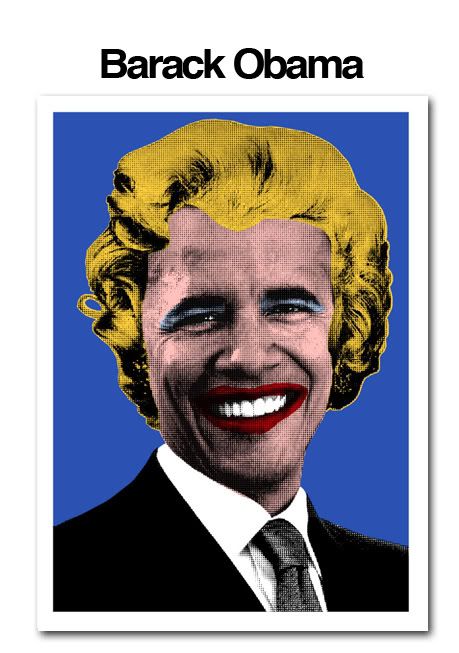
One of Mr. Brainwash's works
It was really kind of an irony that was created as the film progressed. Here were these street artists all around whom Thierry was filming (for a nonexistent documentary) and they inspired him greatly, yet he was one of the worst artists to imitate street art. Artists like Banksy stood for something, yet as it became clear eventually that Thierry was not a filmmaker as he had originally claimed, Banksy suggested in passing that Thierry could make art himself. This led to Thierry not actually making art, but hiring people to make art for him in the street art style. He even invested all of his money in a show in LA and eventually was hired to make cover artwork for famous singers. Even through all of this success, however Mr. Brainwash was shunned within the street art community for his work. He truly commercialized a movement that was supposed to say something about the culture rather than be about gaining money. Throughout the entire film, Banksy used Mr. Brainwash as a counterexample for the movement in order to truly give it a real feel that others could understand. The film ended with Banksy stating, "I always used to encourage everyone I met to make art. I used to think that everyone should do it. I don't really do that so much anymore." While ending extremely negatively, this example truly proved to help define the movement and its ideals to those who know little about it.

Sunday, March 25, 2012

Article of the Week 28: Racism Cartoon

Cartoon by Matt Bors This week, I decided to focus on a cartoon based on something that has been bothering me for some time. This image satires the extremely black and white journalism used in today's international reporting. Our soldiers cannot do wrong, as seen in the image. The American soldier has a list of excuses while the Afghan person who committed the same act has only "Hates Freedom." This kind of unfair treatment is criticized in this cartoon through quite obvious satire. On top of this, the man is shown thinking hard, presumably about the other reasons a person from Afghanistan would kill an American soldier. All of this occurs when one of the excuses for the American soldier is "likes movies." The final statement this cartoon is trying to imply is that as Americans, we give our own troops too much leniency, while other races are discriminated against and seen in an unfair light for the same or similar actions. There is really no reason why this should occur, but it happens all of the time in journalism. Only recently has this finally turned around and less prejudices are shown to foreign peoples. It can only be hoped that this trend continues and that cartoons such as this one are no longer necessary.

Sunday, March 18, 2012

Article of the Week 27: The Inferno 1 of 3

Dante's allusions to the bible and myth are intriguing. His version of hell is different from others before him, but incorporate various versions of mythical beasts from both Greek mythology and the bible. Written in the style of a poem, Dante's allegory focuses on the journey of one man to overcome his sin through going through the nine levels of hell in order to reach heaven. Dante travels with another poet who is his guide and represents Human Reason. Having read up to the sixth circle of hell so far, it seems that Dante uses himself as a means to introduce the common man to hell. He uses his own ignorance in order to envelop the readers in his world. In this way, he does not undermine the mystical qualities of hell while introducing information. If Virgil, his guide, were the newcomer he would seem less holy as he would be more humanized. Thus, Dante uses himself as a lens by which one learns the lessons of hell.

Virgil as human reason also has limitations. He knows all about hell, but cannot control all of it. When reaching the lower gates of hell, he cannot force the harpies to let Dante and him pass. This exemplifies the reliance and faith the religious should have in God, according to Dante. In this scene, he also shows that one cannot survive without God's help.

With much of Dante's focus on religion, it is surprising that he wrote in his native tongue, when at the time all religious texts were supposed to be written in Latin. Even though he helped to spread religion to the masses, a major cause of his, it is surprising that a man with such a strong conviction in religion would write in a language considered vulgar at the time.