How have modes of communication been a reflection of history and society?
How have modern modes of communication been perceived and received by the global community?
Street art is one of the most pure reflections of society as it has no goals besides pure expression. While many consider this movement pure vandalism, it truly attempts to address the many problems in our society today. One of the truest examples of this are the works Banksy created on the wall between Palestine and Israel. While many people merely accept it, Banksy drew immediate attention--and news crews-- to the wall. Much of the movement can be summed up in Banksy's action of illegally vandalizing an illegal wall. While many news crews have been extremely neutral in the topic of these works, people have been extremely polarized over the street art movement.
In one very real sense, the movement is completely illegal, yet others love it for the artistry and satire. Banksy pieces have sold for over half a million dollars, yet they are often painted-over on principle. Nevertheless, many of the critics of this movement still recognize the truly powerful nature of the comments on society. In one sense, Mr. Brainwash was correct, much of the street art movement is about brainwashing people or getting one's point out to the general public. Even though this is partially the case, it is much about making one's own decision. Banksy's statement "One Nation Under CCTV" and Shepard Fairey's "OBEY" truly start to criticize the nature of the society we live in.
While much of the actions taken by these graffiti artists are illegal, the social criticism is important for the advancement of society. These people create their own truths and display them without fear of being criticized. This creates a sort of truth that is not available through most mediums. Street art is one true form of social criticism.
Monday, May 28, 2012

Documentary Post 1: Exit Through the Gift Shop
Exit Through the Gift Shop. Dir. Banksy. Perf. Banksy, Shepard Fairey, Thierry Guetta. Producers Distribution Agency, 2010. DVD.
 Summary:
Exit Through the Gift Shop is an intriguing inside view on the street art movement. Compared to the punk movement in the film, this work focused on artists who tried to make statements about the world through their less-than-legal artwork. This documentary was extremely interesting because it focused on art that was extremely temporary. Some of these works could be somewhere one day and gone the next, yet they made a profound statement on today's culture. From Banksy's maid sweeping dirt under the rug to Shepard Fairey's command that all people obey, this movement is not just about vandalism, but rather the statements behind it.
Rhetorical Analysis:
While focusing mostly on street art in general, a sub-plot was used to keep audience interest. This film focused on the development of the culture as well as the development of one artist himself, Mr. Brainwash. This helped to create interest beyond just curiosity about the movement. Exit Through the Gift Shop starts with Banksy introducing the man who he says is more interesting than himself. This begins a film-long use of foreshadowing and apprehension. This foreshadowing created an uncertain tone that matched well with the film's content, because as soon as Thierry Guetta (Mr. Brainwash) is introduced, the audience knows that there is something a little wrong with him.
It was really kind of an irony that was created as the film progressed. Here were these street artists all around whom Thierry was filming (for a nonexistent documentary) and they inspired him greatly, yet he was one of the worst artists to imitate street art. Artists like Banksy stood for something, yet as it became clear eventually that Thierry was not a filmmaker as he had originally claimed, Banksy suggested in passing that Thierry could make art himself. This led to Thierry not actually making art, but hiring people to make art for him in the street art style. He even invested all of his money in a show in LA and eventually was hired to make cover artwork for famous singers. Even through all of this success, however Mr. Brainwash was shunned within the street art community for his work. He truly commercialized a movement that was supposed to say something about the culture rather than be about gaining money. Throughout the entire film, Banksy used Mr. Brainwash as a counterexample for the movement in order to truly give it a real feel that others could understand. The film ended with Banksy stating, "I always used to encourage everyone I met to make art. I used to think that everyone should do it. I don't really do that so much anymore." While ending extremely negatively, this example truly proved to help define the movement and its ideals to those who know little about it.

Exit Through the Gift Shop is an intriguing inside view on the street art movement. Compared to the punk movement in the film, this work focused on artists who tried to make statements about the world through their less-than-legal artwork. This documentary was extremely interesting because it focused on art that was extremely temporary. Some of these works could be somewhere one day and gone the next, yet they made a profound statement on today's culture. From Banksy's maid sweeping dirt under the rug to Shepard Fairey's command that all people obey, this movement is not just about vandalism, but rather the statements behind it.
Rhetorical Analysis:
While focusing mostly on street art in general, a sub-plot was used to keep audience interest. This film focused on the development of the culture as well as the development of one artist himself, Mr. Brainwash. This helped to create interest beyond just curiosity about the movement. Exit Through the Gift Shop starts with Banksy introducing the man who he says is more interesting than himself. This begins a film-long use of foreshadowing and apprehension. This foreshadowing created an uncertain tone that matched well with the film's content, because as soon as Thierry Guetta (Mr. Brainwash) is introduced, the audience knows that there is something a little wrong with him.
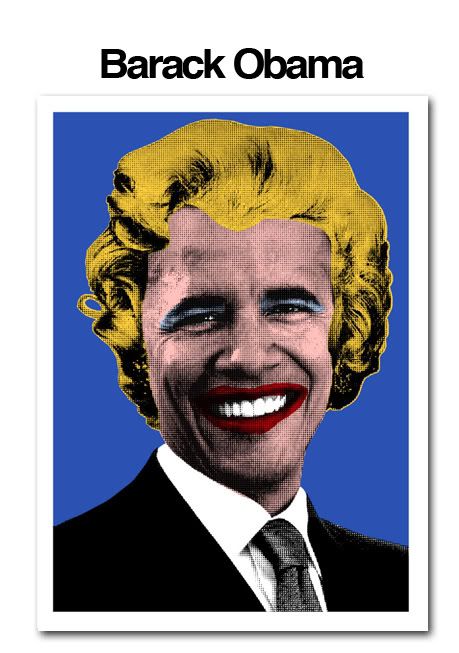 |
| One of Mr. Brainwash's works |
Subscribe to:
Posts (Atom)